
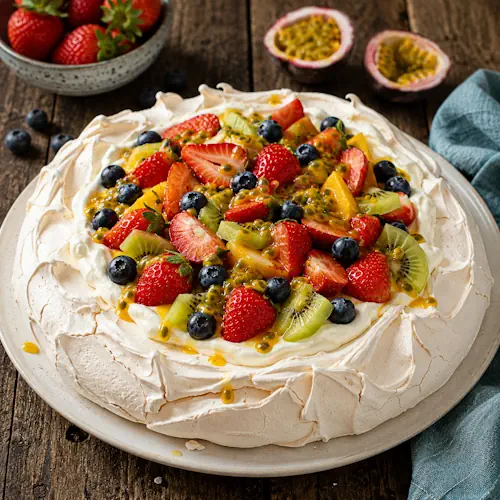
Air Fryer Pavlova
Equipment
- baking paper
- electric mixer
- Mixing bowl
- spatula
Ingredients
- 400 g fresh fruit chopped
- 3 egg whites at room temperature
- 250 ml thickened cream
- ¾ cup caster sugar
- ½ teaspoon cornflour
- ½ teaspoon vanilla extract
- ½ teaspoon white wine vinegar
- 1 tablespoon icing sugar

Instructions
- Preheat the air fryer to 120°C. Line the air fryer basket or a suitable air fryer pan with a piece of baking paper cut to fit.
- Whisk the egg whites until stiff peaks form. Gradually whisk in the caster sugar, one spoonful at a time, until the mixture is thick and glossy.
- Whisk in the vanilla extract, vinegar and cornflour.
- Spoon the meringue onto the prepared baking paper, shaping it into a mound with a slight dip in the centre.
- Air fry for 20 minutes, then reduce the temperature to 100°C and air fry for another 35 minutes, or until the pavlova is crisp on the outside and set underneath.
- Switch off the air fryer and leave the pavlova inside to cool completely.
- Store the cooled pavlova in an airtight container for up to 1 day if not serving immediately.
- Whisk the icing sugar and thickened cream until soft peaks form. Spoon the cream over the pavlova and top with the chopped fresh fruit just before serving.
Notes & Wine Advice
Serving Advice
Top the pavlova only shortly before serving so the meringue stays crisp. Use a colourful mixture of fresh fruit such as strawberries, raspberries, kiwi fruit, mango or passion fruit. Serve as a Dessert with the whipped cream generously spooned into the centre.Air Fryer Advice
Air fryers can vary considerably in temperature and airflow. Check the pavlova towards the end of cooking without repeatedly opening the basket. The outside should feel dry and crisp while the centre remains softer.Cooling Advice
Leave the pavlova inside the switched-off air fryer until completely cool. Cooling it gradually helps reduce sudden temperature changes that can cause excessive cracking or collapse. Some cracking is completely normal for pavlova.Storage Advice
Store the undecorated pavlova in an airtight container at room temperature for up to 1 day. Once topped with cream and fruit, refrigerate leftovers and eat them as soon as possible because moisture will gradually soften the meringue.Wine Advice
A lightly sparkling Moscato d’Asti works particularly well with pavlova. Its gentle sweetness and fresh fruit character complement the meringue, whipped cream and fruit without making the dessert feel excessively rich.Nutrition values
————————————————————————————————–
About Air Fryer Pavlova
Air Fryer Pavlova takes one of Australia’s best-known desserts and adapts it to a compact modern appliance. Pavlova is built around a deceptively simple mixture of egg whites and sugar, yet its distinctive character comes from the contrast between a delicate crisp shell and a soft, almost marshmallow-like interior.
The Story Behind Pavlova
Pavlova takes its name from Russian ballerina Anna Pavlova, who toured Australia and New Zealand during the 1920s. Both countries have long claimed a connection with the dessert, and its precise origin remains the subject of culinary debate. What is beyond dispute is that pavlova became deeply established in the food culture of both countries.
In Australia it developed into a familiar celebration dessert, particularly at gatherings where a large dessert can be placed in the centre of the table and decorated generously with cream and colourful fruit.
What Makes Pavlova Different from Meringue?
Although pavlova begins with the same basic combination of whipped egg whites and sugar used for meringue, its desired texture is different. A conventional crisp meringue is usually dried until relatively firm throughout. Pavlova deliberately retains a softer centre.
The small quantities of cornflour and vinegar contribute to that characteristic interior. The result is a dessert with several textures at once: a fragile outer shell, a softer centre and creamy and juicy elements from the traditional toppings.
An Australian Dessert with Fresh Fruit
Fresh fruit has become one of the visual signatures of Australian pavlova. The pale meringue and cream provide a neutral base for brightly coloured fruit, making the finished dessert particularly striking without complicated decoration.
The fruit also has a culinary purpose. Pavlova contains a substantial amount of sugar, so tart or aromatic fruits provide useful contrast. Passion fruit is especially associated with Australian versions, although berries, kiwi fruit and mango are also common choices.
From Conventional Oven to Air Fryer
Traditional pavlova is prepared in an oven at a relatively low temperature. An Airfryer uses the same principle of heated air but circulates that air much more actively in a smaller cooking chamber.
This recipe adapts the dessert to that environment by using a moderate initial temperature followed by an even lower temperature. The compact cooking space also naturally produces a smaller pavlova, making it practical when a full-size celebration dessert would simply be too much.
Why Sugar Is Essential
Sugar does much more in pavlova than provide sweetness. As it is gradually incorporated into whipped egg whites, it helps stabilise the foam and contributes to the smooth, glossy structure of the meringue.
This is why the caster sugar is added gradually rather than all at once. Fine caster sugar dissolves more readily than coarse granulated sugar, helping create the characteristic smooth meringue mixture before cooking.
A Modern Version of a Classic
The air fryer does not fundamentally change what pavlova is. Egg whites, sugar, cornflour, vinegar, cream and fruit still create the familiar combination that defines the dessert. What changes is primarily the cooking equipment and scale.
That makes Air Fryer Pavlova a useful bridge between a traditional Australia dessert and contemporary home cooking. It keeps the recognisable flavours and textures of pavlova while making the recipe practical for a smaller appliance and a smaller gathering.