Skate con SalsaSkate is a small species of ray—a flat-bottomed kite-shaped fish found in many places around the world, and fairly common in the Sea of Cortez in Baja, Mexico. Until recently it was seldom exported, even though it's a popular food in Europe and parts of Asia. Now, the wings, the edible part, are occasionally available, skinned, in specialty fish markets in the United States. The firm white meat is similar to scallops and in Mexico is usually sautéed in butter and served with a simple sauce and crusty rolls.
Melt the butter in a large skillet over medium-high heat.
Add the skate and cook 2 to 3 minutes per side or until golden brown on the outside and opaque but still moist inside, and just barely flakes when tested with a fork.
Tiburón en Salsa de Cilantro-Yerbabuenaommercial marketing of shark has come into its own in recent years, and it's now available in many United States fish markets and some supermarkets as well. Fresh fish markets in Mexico regularly offer shark of whatever variety is caught along its extensive shoreline. Cazón (dogfish) is used in the Yucatán along the Caribbean coast. Other shark species, such as mako shark and thresher shark are frequently marketed in Mexico and the United States. Here, markets generally sell shark as steaks that are firm and very low in fat, and very similar to swordfish. This tangy sauce goes well with the mild flavor of shark. The sauce can be made ahead.
Put the shark on a plate and rub with the lime juice and garlic.
Let stand about 20 minutes.
Meanwhile, prepare the sauce.
Then, in a large skillet, heat the oil over medium heat until it shimmers.
Pat the fish dry with paper towels and put in the pan.
Cook about 4 to 5 minutes per side or until it is lightly browned on the outside, opaque but still moist inside, and just barely flakes when tested with a fork.
Notes & Wine Advice
Serve hot with a little of the sauce spooned over the fish.
Halibut con Salsa de Naranja y YerbabuenaHalibut goes very well with citrus and mint, as do many of the firm white fish that are common in Mexico. This orange sauce is simple to make and tastes so good that you'll want to make it often. Citrus juices are widely used, especially with fish and poultry, in many parts of Mexico, and halibut works really well with the sauce. Serve with Mexican Rice.
Put the orange juice, rind, mint, sugar, vinegar, crushed pepper, and cornstarch in a small saucepan.
Mix well and bring to a boil.
Cook, stirring, until the sauce thickens slightly, 3 to 4 minutes.
Remove from heat and stir in the butter.
In a nonstick skillet, heat the oil and cook the halibut, 4 to 5 minutes per side or until it is golden brown on the outside, opaque but still moist inside, and just barely flakes when tested with a fork.
Pescado FritoIn or near any fishing port or village, fried fish will be served. Small, whole fresh fish need little adornment, and to fry it crisps up the skin and keeps the meat moist. Accompany the fish with pickled jalapeño chiles, fresh salsa, and French fries.
With a sharp knife, score each fish by making 3 diagonal cuts along the sides.
Dust lightly with flour and sprinkle with salt.
Heat ½ inch of oil over medium-low heat in a large heavy frying pan.
Fry the garlic until golden brown, about 3 minutes.
Remove the garlic and discard.
Fry the fish, 2 at a time, about 8 to 10 minutes, or until golden brown on the outside, opaque through to the bone, but still moist inside when tested with a knife.
Whisk the lime juice, lime zest, red onion, cumin, and salt together in a mixing bowl.
Gradually whisk in the olive oil until the vinaigrette is evenly combined.
Set the lime vinaigrette aside while preparing the fish.
Combine the flour, salt, and black pepper in a shallow dish.
Pat the fish fillets dry with paper towels.
Dredge each fillet lightly in the seasoned flour.
Shake off the excess flour.
Heat the vegetable oil in a large skillet over medium-high heat.
Add two fish fillets without overcrowding the skillet.
Cook for 3–4 minutes on each side until golden brown.
Transfer the cooked fillets to a plate lined with paper towels.
Repeat with the remaining fish fillets.
Check that the fish is opaque and flakes easily with a fork.
Spoon the cool lime vinaigrette over the hot fried fish.
Sprinkle with chopped cilantro and serve immediately.
Notes & Wine Advice
Serving Suggestions
Serve Ensenada lime fish with French fries, roasted potatoes, Mexican rice, cabbage slaw, or a fresh dish from our salad recipes. Place bottled Mexican hot sauce and additional lime wedges on the table.
Recipe Notes
Pat the fish dry before coating it so the flour adheres evenly. Shake off excess flour to prevent a heavy or gummy crust. Fry the fillets in batches so the oil remains hot. Browse our fish recipes for more seafood ideas.
Variations
Use snapper, rock cod, sole, haddock, or another firm white fish. Add smoked paprika or chilli powder to the flour for extra flavor. The lime vinaigrette can also be served with grilled fish or shrimp. Explore our Mexican recipes for more combinations.
Wine Advice
A crisp Albariño complements the lime vinaigrette and fried coating. A fresh Sauvignon Blanc is another lively choice for the fish and cilantro.
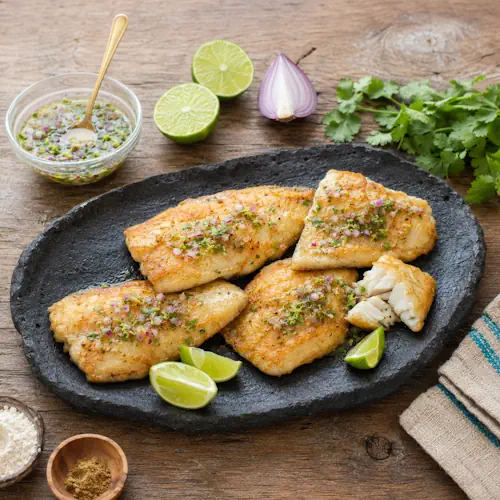
Ensenada lime fish features white fish fillets coated with a light layer of seasoned flour, pan-fried until golden, and served with a cool lime vinaigrette. The contrast between crisp hot fish and the fresh dressing creates a balanced seafood dish with bright coastal flavor.
Ensenada is a port city on Mexico’s Baja California peninsula, where seafood plays an important role in the local cuisine. Fish appears in tacos, ceviche, soups, grilled dishes, and simple fried preparations. Dusting fish with flour before frying is particularly associated with Ensenada and nearby coastal communities.
This recipe is suitable for a family dinner, relaxed weekend meal, or Cinco de Mayo menu. Browse our Mexican recipes for more dishes inspired by the country’s regional cooking.
How the Light Flour Coating Works
The coating used for this Baja fried fish is deliberately thin. Flour absorbs a small amount of surface moisture and forms a delicate crust when it reaches the hot oil. Unlike a thick batter, it allows the texture and flavor of the fish to remain prominent.
Pat the fillets thoroughly dry before dredging them in the flour. Moist fish can create a sticky coating that separates during frying. Shake off all excess flour because loose flour can collect in the oil and burn.
Seasoning the flour with salt and black pepper distributes flavor evenly across the fillets. Smoked paprika, chilli powder, or garlic powder can be added when a stronger seasoning is desired.
Preparing the Fresh Lime Vinaigrette
The vinaigrette combines fresh lime juice, lime zest, red onion, cumin, olive oil, and cilantro. Lime juice provides acidity, while the zest contributes concentrated citrus aroma without introducing additional liquid.
Finely minced red onion adds a crisp, slightly sharp flavor. Ground cumin supplies earthy warmth that connects the dressing with the Mexican character of the dish. Olive oil rounds out the acidity and helps the vinaigrette cling to the fried fillets.
Whisk the lime juice, zest, onion, cumin, and salt together before gradually adding the olive oil. The dressing may separate while standing, so whisk it again immediately before spooning it over the Baja fried fish.
Cooking Baja Fried Fish
Choose fillets of similar thickness so they cook at approximately the same rate. Snapper, rock cod, sole, haddock, and other firm white fish are suitable. Thin fillets may require less time than the suggested three to four minutes per side.
Heat the vegetable oil over medium-high heat until it shimmers but does not smoke. Cook only two fillets at a time so the pan remains hot. Overcrowding lowers the oil temperature and causes the fish to steam instead of developing a golden crust.
Turn each fillet only after the underside is browned and releases easily from the skillet. The fish is ready when the center is opaque and flakes easily with a fork. Drain it briefly on paper towels without covering it, as trapped steam can soften the coating.
Serving Ensenada Lime Fish
Spoon the vinaigrette over the fish immediately before serving. Adding it too early can soften the flour coating. Finish the plate with chopped cilantro, fresh lime wedges, and bottled Mexican hot sauce.
Serve the dish with French fries, roasted potatoes, Mexican rice, cabbage slaw, or a fresh option from our salad recipes. The cool vinaigrette also works well with grilled fish or shrimp.
Store leftover fish and vinaigrette separately in airtight containers for up to two days. Reheat the fish in a skillet or air fryer to restore some crispness. Whisk the refrigerated dressing before serving it again.
With its delicate crust, fresh cilantro, and lively citrus dressing, Ensenada lime fish delivers a straightforward taste of Mexico’s Baja California coast.
Pescado Frito CapeadoFresh fish fillets are dipped in an airy fluffy egg batter and fried in the same way that chiles rellenos are battered and fried. This is a common way to prepare boneless fish fillets in Mexico. Pan-Roasted Tomatillo Sauce or Fresh Salsa Mexicana are good with the fish.
Pescado con Plátanos MachosA spicy citrus marinade with fiery habanero chile infuses the fish with flavor and a hint of heat in the style of Yucatán. (Use protective gloves when handling the hot habanero chile.) Sautéed plantains accompany the fish, and plantains are easy to find these days in supermarkets or Latin-American grocery stores.
In a large shallow glass baking dish, mix together 2 tablespoons of the oil, and the garlic, lime and orange juices, chile, brown sugar, salt, and pepper.
Let stand at room temperature 25 minutes.
Meanwhile, preheat the oven to 200°.
Melt the butter in a large nonstick skillet over medium heat and cook the plantain pieces, turning, until golden brown on all sides, 4 to 6 minutes total.
Season lightly with salt.
Transfer to a plate and keep warm in the oven.
Remove the fish from the marinade, discarding the marinade.
Blot the fish with paper towels.
In a clean, large nonstick skillet, heat the remaining tablespoon of oil.
Put the fish in the pan and cook about 3 minutes per side, or until it is lightly browned on the outside, opaque but still moist inside, and just barely flakes when tested with a fork.
Pescado con Salsa de Chile PoblanoThis wonderful creamy poblano chile sauce from La Cava Restaurant in Mexico City works well with any firm white fish fillets.
46- to 7-ounce white fish fillets, such as sea bass, each about 3⁄4-inch thick
Get Recipe Ingredients
Instructions
Prepare the chiles.
Then, cut out and discard the stem end of the chiles.
Cut open the chiles and remove the seeds and veins.
Rinse the chiles, blot with paper towels and cut them into strips.
Chop them and put them in a blender.
Heat 1 tablespoon of the oil in a medium nonstick skillet, and cook the onion, garlic, and oregano until the onion begins to brown, 3 to 4 minutes.
Scrape the skillet contents into the blender.
Add the cilantro, serrano chile, broth, cream, and ½ teaspoon of the salt.
Blend until smooth, creamy, and green in color.
Transfer the sauce to a small saucepan, and simmer for 2 to 3 minutes to blend the flavors.
Reserve off heat.
In the same nonstick skillet, heat the remaining 1 tablespoon of oil.
Sprinkle the remaining 1⁄2-teaspoon of salt on the fish, and cook 3 to 4 minutes per side, or until it is lightly browned on the outside, opaque but still moist inside, and just barely flakes when tested with a fork.
Reheat the reserved sauce.
Notes & Wine Advice
Serve the fish at once with the sauce spooned on top.
Pescado con Naranjany white fish fillets can be used for this frankly fancy dish. Pacific snapper is often used along Mexico's west coast, and it's excellent with the orange sauce. Oranges and other citrus juices are used in sauces and marinades throughout the country. Mild rice vinegar compliments the sauce and tastes similar to mild Mexican vinegar. Adding a bit of tequila is my idea.
In a small saucepan, boil the orange juice and vinegar until reduced to about ⅓ cup.
Reserve off heat.
Heat the oil in a large nonstick skillet and cook the fish 3 to 4 minutes per side or until it is golden brown on the outside, opaque but still moist inside, and just barely flakes when tested with a fork.
Season with salt and pepper.
Remove the fish to a serving platter.
Add the tequila to the skillet and bring to a boil, scraping up any browned bits.
Add the reserved orange juice reduction to the same skillet and bring to a boil.
Immediately reduce the heat to low and add the butter, 1 piece at a time, whisking just until melted.
Sautéed Fish Fillets with Avocado and Tomatillo Sauce
Pescado con Salsa de Aguacate y TomatilloFirm fish fillets topped with an avocado sauce containing tomatillos makes an unusual and very pretty presentation. Mahimahi, sea bass, or cod, are good choices. Surround the fish with colorful vegetables, such as red and yellow peppers with zucchini. Tiny roasted red potatoes also taste great with the avocado sauce.
In a large nonstick skillet, heat the oil and butter over medium-high heat.
Cook the fish about 3 to 4 minutes per side, until it is golden brown on the outside, opaque but still moist inside, and just barely flakes when tested with a fork.
To provide the best experiences, we use technologies like cookies to store and/or access device information. Consenting to these technologies will allow us to process data such as browsing behavior or unique IDs on this site. Not consenting or withdrawing consent, may adversely affect certain features and functions.
Functional
Always active
The technical storage or access is strictly necessary for the legitimate purpose of enabling the use of a specific service explicitly requested by the subscriber or user, or for the sole purpose of carrying out the transmission of a communication over an electronic communications network.
Preferences
The technical storage or access is necessary for the legitimate purpose of storing preferences that are not requested by the subscriber or user.
Statistics
The technical storage or access that is used exclusively for statistical purposes.The technical storage or access that is used exclusively for anonymous statistical purposes. Without a subpoena, voluntary compliance on the part of your Internet Service Provider, or additional records from a third party, information stored or retrieved for this purpose alone cannot usually be used to identify you.
Marketing
The technical storage or access is required to create user profiles to send advertising, or to track the user on a website or across several websites for similar marketing purposes.