Although avocado is mostly used in dips and salads in the United States, it makes its appearance in sauces, soups and even stews in regions where it grows. When gently warmed, this creamy, garlicky sauce with a hint of heat is excellent on grilled chicken or fish, and it is equally good as a condiment for burgers. The sauce may be served cold and do double duty as a dip or salad dressing. You will want to thin the sauce slightly if using warm. If using as a salad dressing, add enough water to achieve an easily pourable consistency and cut the chipotle pepper in half or omit it altogether.
Remove and discard the chipotle stem if it has one.
Place all the ingredients in a high-speed blender or food processor and add water a teaspoon (5 ml) at a time to purée to a smooth, thick but easily pourable sauce.
If using the sauce warm, scrape into a small saucepan and place over a low heat.
Bring to just under a boil, stirring often—about 2 to 3 minutes.
Notes & Wine Advice
Serve warm over grilled chicken or fish or as a drizzle over fried chicken tacos.
We enjoy making this in the winter, when tangerines are at their ripest, and we need a touch of brightness to combat the winter blues. We use this tangy, spicy vinaigrette on salads, grilled mushrooms, roasted beets or over a salad of shaved fennel and arugula
This is an incredibly versatile sauce that we have used for everything from firm white fish, shellfish, chicken or pork, or even as the basis of a stew with chickpeas or on grilled eggplant. This tangy, aromatic sauce that is tempered with a bit of sugar and coconut milk also has some kick thanks to the jalapeño pepper. Feel free to reduce or increase the amount of pepper to your individual taste. The same is true of the sugar in this recipe—you may find you like your sauce a little less tangy so add sweetness accordingly.
Indian food lovers will recognize this simmer sauce as korma, a well flavored and creamy nut-based sauce that can be made with almonds or cashews. Garam masala is the basis for the classic Indian flavor as are the high notes of cardamom, which is almost minty in taste. While you can process your own cashews into a butter or paste very easily, there are so many jarred cashew butters on the market it’s often easier to use one of these preparations. We call for cream in this sauce, but it can also be made with coconut cream, and it’s just as good. While this sauce is most classically used as a simmer sauce for chunks of boneless chicken, it is also excellent for mixed vegetables or pieces of firm fish like swordfish or catfish too.
Romesco is a classic nut-based Spanish sauce that is most often served with fish, although we find that it is also excellent for poultry, especially for braised chicken thighs that have first been browned until the skin is crispy. While romesco sauces are usually made with pine or hazelnuts, we love the creaminess of marcona almonds—a Spanish almond that is less woody in flavor than more traditional varieties.
Other hallmarks of romesco sauces are roasted tomatoes, red bell peppers and vinegars. Piment d’espelette is a mild, tasty chili pepper largely cultivated in France but which is integral to the Basque cuisine of Northern Spain. We find that it adds a mild spice that enlivens the sauce. You can certainly omit it or substitute another mild pepper if you cannot find piment d’espelette.
Yuzu is an extremely sour Japanese citrus fruit that is most often combined with soy sauce as a dip for fried foods, particularly dumplings. We find that the brightness of the yuzu makes it work well as a pan sauce for seared chicken breasts. This sauce can also be used as a dip for fried chicken wings.
Heat the oil in a small sauté pan over medium heat.
Add the shallot and sauté until translucent, about 2 to 3 minutes.
Add the grated ginger and sauté for 1 minute more.
Add the sake and stir well with a wooden spoon, until most of the sake evaporates from the pan and about 1 tablespoon (15 ml) is left, about 2 to 3 minutes.
Add the yuzu juice and soy sauce and simmer until the mixture is reduced by half, about 2 to 3 minutes.
Add the chicken stock and mix well.
Simmer for 8 to 9 minutes or until the mixture is reduced by half and the mixture is thick enough to lightly coat the back of a spoon.
Season with the white pepper.
Add the butter and stir until melted.
Serve as a sauce to accompany chicken or fish or as a dipping sauce for dumplings.
Both coconut and turmeric fall into the realm of newly popular superfoods, and together they are a healthy food powerhouse. We like to use fresh turmeric for this sauce, both for its milder flavor that combines well with the sweetness of the coconut and the white sweet potato (found in Caribbean markets), as well as its deep orange hue.
This complex sauce, redolent with the warmth of ginger and cardamom, can be used two ways—either as a simmering sauce or a spoon-over sauce. To simmer chicken, simply add the chicken pieces to the sauce before reducing it and simmer on medium low heat. You can also make this sauce separately and spoon over chicken or turkey that you have prepared by your favorite dry heat method such as roasting or searing.
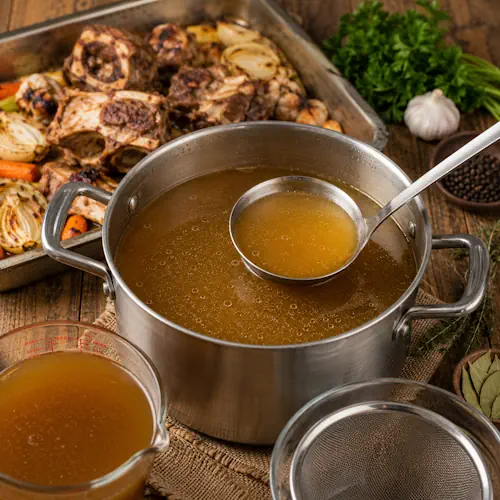
Classic Meat Stock is a rich, slow-simmered foundation made from roasted beef, veal, lamb, or venison bones with aromatic vegetables and herbs. This deeply flavored stock is ideal for soups, stews, gravies, braises, and sauces, providing exceptional depth to countless savory recipes.
Arrange the bones in a large roasting pan and roast for 15 minutes.
Brush or stir the tomato paste over the bones until evenly coated.
Add the onion, carrots, celery, and garlic to the roasting pan and roast for another 10 minutes.
Transfer the roasted bones and vegetables to a large stockpot.
Add the bay leaves, peppercorns, parsley, thyme, and cold water.
Bring the stock slowly to a gentle simmer over medium heat.
Reduce the heat to low and simmer gently for about 3 hours, skimming off any foam and impurities that rise to the surface.
Strain the stock through a fine-mesh sieve into heatproof containers.
Cool the stock quickly before refrigerating.
Remove the solidified fat from the surface before using or freezing.
Notes & Wine Advice
Recipe Notes
Roasting the bones and vegetables first develops a deeper color and a richer, more complex flavor.Keep the stock at a gentle simmer rather than a rolling boil to produce a clear, clean-tasting broth.Freeze the stock in small portions so it’s easy to use when making soups, sauces, and stews.Homemade stock can be refrigerated for up to five days or frozen for up to three months.
Wine Advice
This recipe is a cooking staple rather than a finished dish, so no wine pairing is necessary. Use the finished stock as the foundation for meat sauces and braised dishes where the appropriate wine can be selected later.
Classic Meat Stock is one of the most valuable foundation recipes in traditional cooking. Slowly simmered from roasted bones, aromatic vegetables, and fresh herbs, it develops a deep, rich flavor that simply cannot be matched by store-bought stock cubes or concentrates. Whether you’re preparing hearty soups, silky sauces, braised meats, or flavorful gravies, a well-made homemade stock forms the backbone of countless classic recipes.
Why You’ll Love Classic Meat Stock
This homemade meat stock develops incredible depth through roasting the bones before simmering them slowly with vegetables and herbs. The result is a clear, rich stock that’s perfect for freezing in portions and using whenever a recipe calls for superior flavor. Browse our Basic Recipes, Meat Recipes, Soup Recipes, French Recipes, and Sauce Recipes for more inspiration.
How To Make Homemade Meat Stock
Roast the bones with tomato paste and vegetables to caramelize their natural sugars before transferring everything to a large stockpot. Add herbs, peppercorns, and cold water, then simmer gently for several hours while regularly skimming away impurities. Finally, strain the stock through a fine sieve and cool it quickly before storing. This slow process produces a beautifully clear stock with outstanding flavor.
Using Classic Meat Stock
Use this homemade meat stock as the base for soups, stews, casseroles, gravies, pan sauces, braised meats, risottos, and many other savory dishes. It adds depth and richness that instantly elevates everyday cooking.
Storage Tips
Store Classic Meat Stock in airtight containers in the refrigerator for up to five days or freeze for up to three months. Freeze in smaller portions or ice cube trays for convenient use. For additional food safety guidance, visit the FDA Food Safety website.
Once you’ve made homemade stock from scratch, you’ll immediately notice the difference it makes. Rich, aromatic, and incredibly versatile, Classic Meat Stock is a kitchen essential that rewards the extra time with exceptional flavor in every recipe.
Vegetable stock is suitable both for vegetarian and meat-based sauces. Keep in mind that it is a darker stock than chicken stock and this will affect the color of your final preparation.
MAKES: about 2 quarts (2 L)
To provide the best experiences, we use technologies like cookies to store and/or access device information. Consenting to these technologies will allow us to process data such as browsing behavior or unique IDs on this site. Not consenting or withdrawing consent, may adversely affect certain features and functions.
Functional
Always active
The technical storage or access is strictly necessary for the legitimate purpose of enabling the use of a specific service explicitly requested by the subscriber or user, or for the sole purpose of carrying out the transmission of a communication over an electronic communications network.
Preferences
The technical storage or access is necessary for the legitimate purpose of storing preferences that are not requested by the subscriber or user.
Statistics
The technical storage or access that is used exclusively for statistical purposes.The technical storage or access that is used exclusively for anonymous statistical purposes. Without a subpoena, voluntary compliance on the part of your Internet Service Provider, or additional records from a third party, information stored or retrieved for this purpose alone cannot usually be used to identify you.
Marketing
The technical storage or access is required to create user profiles to send advertising, or to track the user on a website or across several websites for similar marketing purposes.