“Mom made a lot of cornstarch pudding,” recounts a young mother. “She would make it for Sunday lunch, especially if company was coming, and we would eat it warm. Often we would spread crackers with peanut butter and dunk them in it.”
The most typical flavor was vanilla, but some cooks delighted their families by putting a dollop of chocolate right in the center of the full serving dish. “Mom would save a little pudding out, mix it with chocolate syrup, then spoon it back into the middle to give it all a little more flavor,” remembers a middle-aged woman.
Preferences vary as to the proper temperature at which cornstarch should be served. Some insist on having it warm. Others are equally adamant about eating it cold. In cases where the batch is larger than the call for it, the first round is served hot; the leftovers are chilled.
These cookies are a relatively new invention, first appearing about 30–35 years ago. Said one grandmother in her mid-50s, “I don’t remember whoopie pies as a little girl, but I do know they were around before we were married. Probably someone just made them up!”
Another grandmother in her late 50s knew of them “just since we’re married, and that not in the first years.”
These individual cakes are well suited to lunch-box travel and food stands at farm sales. The icing is spread between the two cookie halves so it doesn’t rub off when wrapped, as cupcake icing does.
The original—and still most commonly made—whoopie pie is chocolate. Oatmeal and pumpkin variations have developed more recently.
Although Christmas is celebrated quietly, some families have kept a few cooking traditions, especially to honor visitors over the holidays.
At the turn of the century, sand tarts were baked in some homes “at Christmastime, and usually only then. We would cut them out in different shapes,” an elderly woman remarks. The traditional Pennsylvania Dutch Cookies—lebkuchen, pefferniss, and springerle—were not commonly eaten by the Amish. Explained an Amish grandfather, “We had more cookies around at Christmas, but not really special kinds.”
Today cookie-baking is associated more with holiday activity, and sand tarts continue as favorites, perhaps because children enjoy both cutting them out and choosing special shapes to eat.
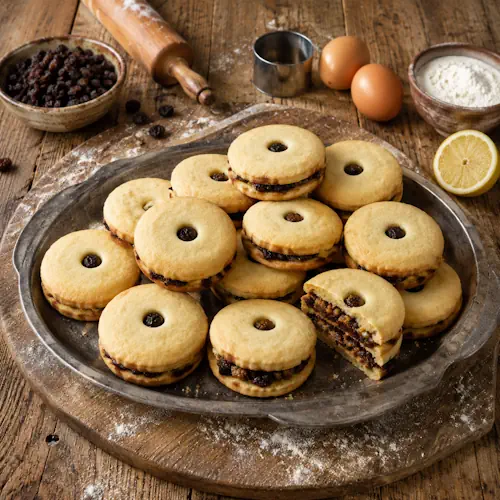
Soft Amish-style cookies filled with a thick, lightly sweetened raisin and lemon mixture. Each cookie consists of two tender rounds enclosing a fruity centre, making a comforting treat for coffee, high tea or gift-giving.
Place the chopped raisins, sugar, water, flour and lemon juice in a medium saucepan.
Bring the mixture to a gentle boil over medium heat.
Stir constantly until the filling becomes thick.
Remove the saucepan from the heat.
Allow the filling to cool completely.
For the Cookie Dough
Place the vegetable shortening and sugar in a mixing bowl.
Beat with an electric mixer until light and creamy.
Add the beaten egg, milk and vanilla extract.
Beat until evenly combined.
Sift the flour, baking soda and baking powder into a separate bowl.
Gradually add the dry ingredients to the creamed mixture.
Mix until a soft dough forms.
Cover the dough.
Refrigerate for at least 4 hours or overnight.
For Shaping and Baking
Preheat the oven to 175°C.
Lightly coat a baking sheet with cooking spray.
Roll the chilled dough on a lightly floured surface to a thickness of 6 mm.
Cut 8 equal rounds from the dough.
Place 4 rounds on the prepared baking sheet.
Spoon 1 teaspoon raisin filling into the centre of each round.
Make a small hole in the centre of each remaining dough round.
Place one perforated round over each filled cookie.
Leave the edges unpressed so steam can escape through the centre opening.
Bake for approximately 20 minutes, or until lightly golden.
Transfer the cookies to a wire rack.
Allow them to cool before serving.
Notes & Wine Advice
Serving Suggestions
Serve the cookies with tea, coffee or a glass of cold milk. They also work well on a high-tea platter or packaged in a small box as a homemade gift.
Recipe Notes
Allow the raisin filling to cool completely before assembling the cookies. Warm filling can soften the dough and make it difficult to handle. The small opening in the upper cookie allows steam to escape during baking.
Variations
Add ground cinnamon, orange zest or a pinch of cloves to the raisin filling. Chopped dates, dried figs or dried cranberries can replace part of the raisins. Lard may be used instead of vegetable shortening, but the cookies will no longer be vegetarian.
Storage
Store completely cooled cookies in an airtight container at room temperature for up to three days. Refrigerate them when keeping them longer. The cookies can be frozen for up to one month with baking paper between the layers.
Wine Advice
A gently sweet Riesling complements the raisins and subtle lemon flavour. Moscato is another suitable choice for dessert or high tea.
Amish raisin pocket cookies are soft, old-fashioned treats made from two rounds of tender dough enclosing a thick raisin filling. The fruity centre is gently flavoured with lemon, while the small opening in the upper layer allows steam to escape during baking.
An Old-Fashioned Filled Cookie
Filled cookies are closely associated with traditional home baking because they turn basic pantry ingredients into something more substantial. Instead of mixing raisins directly into the dough, this recipe cooks them with sugar, water and flour to produce a soft, jam-like centre.
The combination of a tender outer cookie and moist filling creates a contrast in texture. These cookies are larger and more satisfying than ordinary biscuits, making one cookie a suitable serving with tea or coffee.
Preparing the Raisin Filling
Finely chop or grind the raisins before cooking. Smaller pieces absorb the liquid more evenly and make the finished cookies easier to assemble and eat. Combine the raisins with sugar, water, flour and lemon juice in a saucepan.
Stir continuously as the mixture heats because the flour can settle on the bottom and form lumps. Once the filling reaches a gentle boil, it should begin to thicken. Remove it from the heat when it resembles a thick preserve.
Allow the filling to cool completely before placing it on the dough. Warm filling softens the shortening and can make the lower cookie rounds difficult to move. The mixture will also become firmer as it cools.
Making Amish Raisin Pocket Cookies
Vegetable shortening gives the dough a soft, crumbly texture. Cream it thoroughly with the sugar before adding the beaten egg, milk and vanilla. Gradually mix in the sifted flour, baking soda and baking powder until a soft dough forms.
The dough needs several hours in the refrigerator. Chilling firms the shortening, hydrates the flour and makes the dough easier to roll. Overnight chilling is convenient, but four hours is generally sufficient for this small batch.
Shaping the Cookies
Roll the chilled dough to a thickness of approximately 6 mm. Keep the work surface lightly floured, but avoid adding excessive flour because this can make the cookies dry. Cut eight equal circles to create four filled cookies.
Place a teaspoon of filling in the centre of four rounds. Make a small opening in each remaining round before positioning it over the filling. A clean piping nozzle or the end of a small drinking straw is safer and more hygienic than the thimble suggested in many older recipes.
The edges do not need to be firmly pressed together. Leaving them relaxed and adding a centre opening gives steam somewhere to escape. This reduces the likelihood of the filling forcing its way out between the dough layers.
Baking and Serving
Bake until the cookies are set and lightly golden. Because the filling is enclosed, allow them to cool before eating. Hot raisin filling can retain heat longer than the surrounding cookie.
Serve them with coffee, tea or milk. They also fit well on a platter with recipes from the cookie collection. For a larger selection, browse the dessert recipes or combine them with other choices from the fruit recipes.
Variations and Dietary Notes
Ground cinnamon, cloves or orange zest can be added to the filling. Chopped dates, dried figs or cranberries may replace part of the raisins. Using lard instead of shortening produces a traditional flavour but makes the cookies unsuitable for vegetarian diets.
The recipe contains wheat, egg and cow’s milk. Check the shortening label when avoiding soy or other allergens. General guidance about preparation and storage is available from the FDA page on safe food handling.
Storage
Keep completely cooled cookies in an airtight container at room temperature for up to three days. Place baking paper between layers to prevent sticking. Refrigeration extends their storage life, although it can make the outer dough slightly firmer.
The cookies can be frozen for up to one month. Wrap them individually and defrost at room temperature before serving. These Amish raisin pocket cookies are particularly enjoyable when the dough is tender and the fruit filling remains soft.
This cookie was not part of the weekly baking; it requires far too much time in preparation! But it has traditionally been part of holiday cookie-making.
Many varieties of dried fruit and nut cookies filled the farm pantries. Chewy and substantial, they also retained their moisture longer because of the presence of the fruit.
Here are hermits, those old-fashioned cousins of jumbies, ice box cookies, date and nut, and mincemeat cookies.
To provide the best experiences, we use technologies like cookies to store and/or access device information. Consenting to these technologies will allow us to process data such as browsing behavior or unique IDs on this site. Not consenting or withdrawing consent, may adversely affect certain features and functions.
Functional
Always active
The technical storage or access is strictly necessary for the legitimate purpose of enabling the use of a specific service explicitly requested by the subscriber or user, or for the sole purpose of carrying out the transmission of a communication over an electronic communications network.
Preferences
The technical storage or access is necessary for the legitimate purpose of storing preferences that are not requested by the subscriber or user.
Statistics
The technical storage or access that is used exclusively for statistical purposes.The technical storage or access that is used exclusively for anonymous statistical purposes. Without a subpoena, voluntary compliance on the part of your Internet Service Provider, or additional records from a third party, information stored or retrieved for this purpose alone cannot usually be used to identify you.
Marketing
The technical storage or access is required to create user profiles to send advertising, or to track the user on a website or across several websites for similar marketing purposes.
To provide the best experiences, we use technologies like cookies to store and/or access device information. Consenting to these technologies will allow us to process data such as browsing behavior or unique IDs on this site. Not consenting or withdrawing consent, may adversely affect certain features and functions.
Functional
Always active
The technical storage or access is strictly necessary for the legitimate purpose of enabling the use of a specific service explicitly requested by the subscriber or user, or for the sole purpose of carrying out the transmission of a communication over an electronic communications network.
Preferences
The technical storage or access is necessary for the legitimate purpose of storing preferences that are not requested by the subscriber or user.
Statistics
The technical storage or access that is used exclusively for statistical purposes.The technical storage or access that is used exclusively for anonymous statistical purposes. Without a subpoena, voluntary compliance on the part of your Internet Service Provider, or additional records from a third party, information stored or retrieved for this purpose alone cannot usually be used to identify you.
Marketing
The technical storage or access is required to create user profiles to send advertising, or to track the user on a website or across several websites for similar marketing purposes.