Serves 6 To 8
Let’s say you don’t want to bother with a whole chicken. Or let’s say you’re me, and you’re just a person who happens to love the inexpensive versatility of chicken thighs and legs—you can cook them just about any old way, and because they’re the fattiest parts of the bird, they have the most flavor. That’s a win-win in my book. This is such an easy recipe—three ingredients, folks—that I recommend it to people when they ask me what they should make for dinner on a busy weeknight. It’s not exactly “barbecuing” because you’re not cooking meat over a low heat and infusing it with smoke, but it has a similar flavor profile and it makes for some really good eating. Note that I prefer bone-in thighs, but you can use boneless just as well if you like.
Set up your charcoal or gas grill for indirect heat: Build a fire in your grill, leaving one side free of coals.
When the coals are covered with gray ash and the temperature is medium-high (you can hold your hand 5 inches above the coals for about 5 seconds), you are ready to cook.
(For a gas grill, turn one of the burners down to low or off, cover, and heat for 15 minutes.
)
Wash the chicken pieces thoroughly in cold water, then dry them with paper towels or a clean kitchen towel.
Rub the pieces all over with the vinegar.
Apply the rub all over the exposed areas of the chicken pieces.
Arrange the chicken on the hot grate above the drip pan in your cooker and away from the coals or burner, skin side down.
Cover and grill for about 40 minutes, opening the grill once about halfway through the cooking time to flip the pieces and covering the cooker again, until the skin is crisp, the meat is cooked through, and the thigh meat registers 180°F on an instant-read thermometer.
Transfer to plates and serve immediately with the sauce on the side for dipping, if you like.
Grab the chicken with one breast in each hand and open it like a book, exposing the cavity of the bird—you’ll hear a crack, most likely.
Running from the middle of the bird down between the two legs is the so-called “soft bone” or “keel bone”—this is the breastbone.
It’s a triangular shape that is firm toward the middle of the bird but becomes soft flexible cartilage as it tapers down between the legs.
To remove it, use a paring knife to cut down either side of it.
Once you’ve cut it free, use your fingers to loosen and then pull out the breastbone.
Discard the bone, and your chicken is good to go.
Rub the chicken all over with the vinegar, then season it on both sides with salt and pepper.
Generously smear the rub under and over the skin and on the interior of the bird.
Place in a baking pan, cover with plastic wrap, and refrigerate at least three hours or preferably overnight.
When you are ready to cook the chicken, preheat half the grill to medium-high (or build a medium-high-heat fire on one side of a charcoal grill); leave the other half unheated.
Place the chicken skin side down over the heated side and grill until the skin begins to color and char marks form, about 5 minutes.
Flip over and grill 5 minutes more.
Move the chicken to the unheated side.
Close the lid and cook, making sure the chicken is flat against the grate, skin side up, until an instant-read thermometer inserted into the thickest part of a thigh without touching bone registers 180°F, approximately 30 to 40 minutes.
Transfer to a platter and let rest for 5 to 10 minutes before carving.
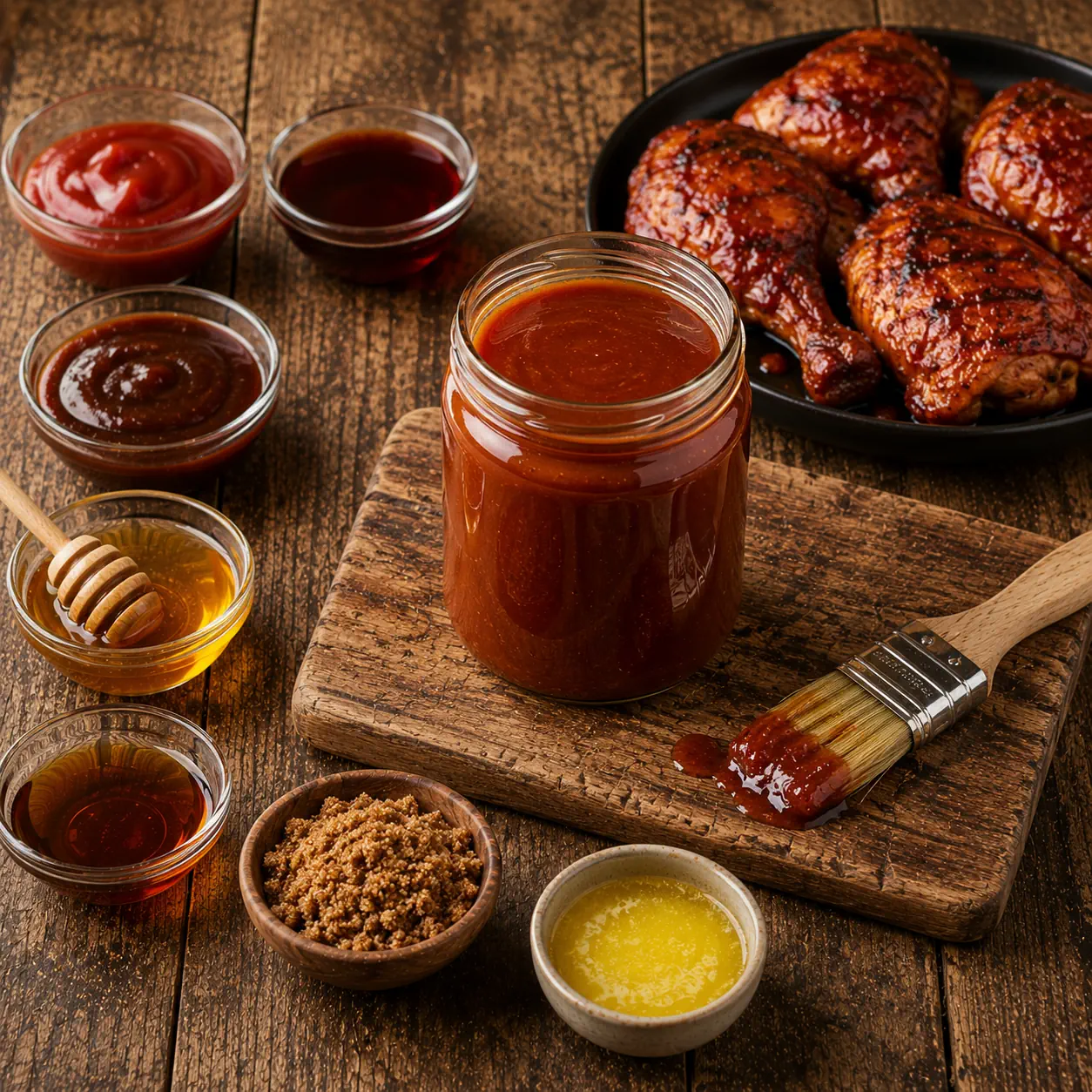
Chicken glaze combines sweet honey, maple syrup, smoky barbecue sauces, and rich brown sugar into a glossy homemade glaze perfect for grilled chicken and barbecue dishes. The glaze develops deep caramelized flavor while warming gently on the stove, creating the perfect balance between smoky sweetness, tangy vinegar, and buttery richness.
This barbecue glaze remains popular because it transforms simple grilled chicken into rich sticky barbecue perfection with very little effort. Honey, maple syrup, and brown sugar create thick glossy texture while vinegar sauce and hickory barbecue sauce balance the sweetness with smoky tangy depth.
Why chicken glaze creates sticky barbecue flavor
The popularity of chicken glaze continues to grow because sweet glazes caramelize beautifully on grilled chicken while locking in moisture and flavor. Warming the glaze gently before brushing it onto the meat also helps create smooth glossy coverage during grilling.
Another reason this barbecue glaze works so well is the balance between sweet and smoky ingredients. Ketchup creates a rich tomato base while vinegar sauce adds tanginess and hickory sauce contributes deep smoky barbecue flavor.
Honey and maple syrup create rich glossy texture
The honey and maple syrup give this chicken glaze its signature sticky texture and sweet barbecue richness. Brown sugar deepens the caramel flavor while melted butter creates smoothness throughout the glaze.
If you enjoy homemade barbecue sauces and glazes, you may also like our Bourbon BBQ Sauce, another flavorful barbecue recipe packed with smoky sweet richness.
Texture plays an important role in this recipe. The glaze becomes smooth, glossy, and slightly thick after warming, making it perfect for brushing over chicken thighs, wings, drumsticks, or even whole grilled chicken.
The glaze also stores very well in the refrigerator, making it ideal for preparing ahead before cookouts and barbecue gatherings. Reheating before serving helps restore the smooth glossy consistency.
Perfect glaze for grilled chicken and barbecue recipes
This chicken glaze works perfectly for grilled chicken thighs, barbecue wings, smoked poultry, whole roasted chicken, and even pork recipes because the sweet smoky flavor complements grilled meats beautifully.
The glaze also works wonderfully during the final minutes of grilling because the sugars caramelize lightly without burning too quickly. Brushing several thin layers over the chicken creates even richer barbecue flavor and shine.
Proper food handling remains important whenever preparing sauces and grilled poultry dishes. Chicken should always be cooked safely and handled carefully during grilling and serving. For additional poultry preparation and food safety guidance, visit the FDA.
Ultimately, chicken glaze delivers sticky sweetness, smoky barbecue richness, and glossy caramelized flavor in an easy homemade recipe perfect for grilled chicken and outdoor cookouts.
prevents your screen from turning off”
Chicken Glaze
Sweet and smoky homemade barbecue glaze for grilled chicken and barbecue dishes.
1cupJack’s Old South Hickory Sauceor make your own
Instructions
Prepare your smoker and heat it to 275°F.
Apply the rub all over the exposed areas of the chicken and into the chicken’s cavity as well.
Place the seasoned bird with its breast side up on a meat rack with handles down, so the bird will be raised above the surface of a pan.
Then set the rack inside a deep aluminum baking pan.
Pour water into the bottom of the pan, underneath the meat rack.
Carefully transfer the pan into the smoker, cover, and smoke for about 3 hours, or until the breast meat reaches a temperature of 165°F and the dark meat reaches 180°F.
Remove the pan from the smoker and allow the chicken to rest on its rack in the pan, uncovered, for 15 minutes.
Transfer the chicken to a wooden carving board, carve the chicken into pieces, and serve with the sauce on the side.
25- to 6-pound inexpensive boneless pork shoulders (Boston butt only) or 2 brisket flats, which will support the hog in the smoker (you will not eat these)
Instructions
1 to 3 helper humans, needed for carrying the whole hog
Prep the hog: On a long table covered with clean butcher paper or other sanitary covering, lay long strips of aluminum foil until the table is completely covered.
Place the hog, which has been butchered and split with its head on and its feet removed, flat on its back on top of the foil.
Score the hog: With a sharp chef’s knife, make shallow cuts in a crisscross pattern in the meat all along each side of the spine of the hog, especially making sure to create squares where the ribs connect to the spine.
Then crack and pull down each side of the hog, starting from the spine.
You want the hog to be laying semi-flat (or as flat as you can get it, without removing the sides from the spine), so that you can easily reach inside it.
Remove the membrane (or “silver”) from the backs of the ribs on each side: The easiest way to do that is to make a small incision just below the length of the breastbone.
Work your fingers underneath the membrane until you have 2 to 3 inches cleared.
Grab the membrane with one of my rib skimmers or a towel or your fingers and gently but firmly pull it away from the ribs.
Pulling off the membrane exposes loose fat that will need trimming, so take your sharp paring knife and cut away any excess exposed fat.
Use a meat saw to split and saw down in between the ribs and down each side of the spine of the hog.
You’re going to cut the ribs on both sides 3 inches off the spine.
Why?
Doing this makes baby back ribs out of full-size spareribs.
Take care to saw only the bone, and try not to pierce the skin on the bottom of the hog.
This will ultimately make it easier for you to serve the ribs.
“Barbecue is an evolving art, and even though pitmasters like me still rely on the ancient technique of smoking meat over fire, we still have to evolve with the times.”Makes 12 Appetizer Or 6 Main Course ServingsWhen I make cupcake chicken for competitions, we have to use bone-in chicken thighs. If you’re cooking in your backyard, you can surely use the boneless thighs—it will save you a lot of time and aggravation.
In a large heavy Dutch oven or stockpot, combine all the ingredients.
Cover with enough cold water to submerge all the ingredients, about 3 quarts.
Over moderately high heat, bring the stock to a boil.
Reduce the heat to low to let the stock simmer gently for at least 3 hours and not more than 4, periodically using a slotted spoon to skim the surface and discard the fat that collects on the surface.
Remove the stock from the heat, cover the pot, and allow the stock to cool completely.
Discard the bones and vegetables.
Line a fine-mesh strainer or colander with several layers of cheesecloth.
Place it over a large bowl.
You may need to strain it two or three times to remove all the solids.
Refrigerate the stock overnight.
The next day, the stock should be golden in color.
Skim any fat that collects on the surface and discard the solids.
After skimming, use immediately or pour it into containers to store.
Store the stock in the refrigerator for five days, or in the freezer for about three months.
Make sure to discard any fat that accumulates on top of the stock before using.
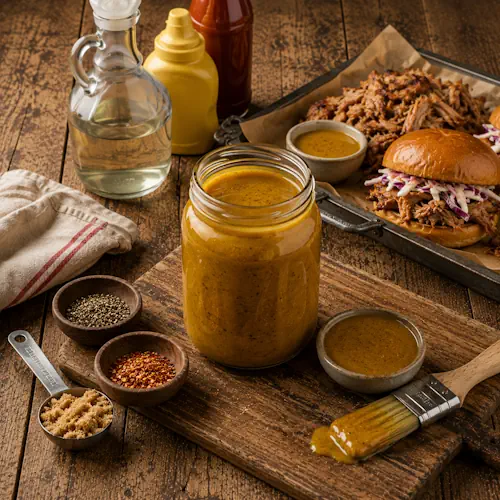
Carolina mustard barbecue sauce combines tangy yellow mustard, sharp vinegar, brown sugar, and smoky spices into a bold Southern-style barbecue sauce packed with sweet and tangy flavor. The sauce develops smooth richness while gently simmering, creating the perfect balance between mustard sharpness, vinegar brightness, and smoky sweetness.
This mustard barbecue sauce remains popular because it delivers classic South Carolina barbecue flavor using simple pantry ingredients. Yellow mustard forms the rich tangy base while vinegar adds brightness and brown sugar softens the sharpness with deep caramel sweetness.
Why Carolina mustard barbecue sauce tastes bold and balanced
The popularity of Carolina mustard barbecue sauce continues to grow because mustard-based sauces pair beautifully with smoked pork, grilled chicken, pulled pork sandwiches, and barbecue ribs. The sharp mustard flavor cuts through rich meats while the vinegar keeps the sauce fresh and vibrant.
Another reason this barbecue sauce works so well is the contrast between sweet and tangy ingredients. Brown sugar balances the mustard while chili powder and red pepper flakes create gentle warmth and smoky barbecue depth.
Mustard and vinegar create classic Southern barbecue flavor
The mustard gives this Carolina mustard barbecue sauce its signature golden color and bold tangy character. Vinegar brightens the sauce while ketchup adds subtle sweetness and smooth texture throughout the mixture.
If you enjoy homemade barbecue sauces, you may also like our Bourbon BBQ Sauce, another flavorful barbecue sauce recipe packed with smoky richness and bold grilling flavor.
Texture plays an important role in this recipe. Slowly warming the sauce without boiling helps preserve a smooth glossy consistency while allowing the spices and sugars to blend evenly into the mustard base.
The sauce also stores extremely well inside the refrigerator, making it perfect for preparing ahead before barbecue gatherings and cookouts. As the sauce rests, the flavors continue deepening and balancing even further.
Perfect sauce for pulled pork chicken and barbecue sandwiches
This Carolina mustard barbecue sauce works perfectly with pulled pork, smoked chicken, grilled pork chops, barbecue sandwiches, ribs, sausages, and roasted meats because the mustard and vinegar cut through rich smoky flavors beautifully.
The sauce also works wonderfully as a dipping sauce, sandwich spread, or finishing glaze brushed lightly over grilled meats during the final minutes of cooking.
Proper food handling remains important whenever preparing homemade sauces for grilled meats and barbecue dishes. Store sauces properly refrigerated and always use clean utensils during serving. For additional food preparation and safety guidance, visit the FDA.
Ultimately, Carolina mustard barbecue sauce delivers tangy mustard flavor, sweet smoky richness, and classic Southern barbecue character in a bold homemade sauce perfect for grilling and smoked meats.
prevents your screen from turning off”
Carolina Mustard Barbecue Sauce
Tangy mustard barbecue sauce with vinegar, brown sugar, and Southern barbecue flavor.
Makes 3½ CupsThis sauce is designed for lighter-flavored meats like chicken and turkey, and it’s dynamite on them. You could use it on shrimp and seafood as well
To provide the best experiences, we use technologies like cookies to store and/or access device information. Consenting to these technologies will allow us to process data such as browsing behavior or unique IDs on this site. Not consenting or withdrawing consent, may adversely affect certain features and functions.
Functional
Always active
The technical storage or access is strictly necessary for the legitimate purpose of enabling the use of a specific service explicitly requested by the subscriber or user, or for the sole purpose of carrying out the transmission of a communication over an electronic communications network.
Preferences
The technical storage or access is necessary for the legitimate purpose of storing preferences that are not requested by the subscriber or user.
Statistics
The technical storage or access that is used exclusively for statistical purposes.The technical storage or access that is used exclusively for anonymous statistical purposes. Without a subpoena, voluntary compliance on the part of your Internet Service Provider, or additional records from a third party, information stored or retrieved for this purpose alone cannot usually be used to identify you.
Marketing
The technical storage or access is required to create user profiles to send advertising, or to track the user on a website or across several websites for similar marketing purposes.
To provide the best experiences, we use technologies like cookies to store and/or access device information. Consenting to these technologies will allow us to process data such as browsing behavior or unique IDs on this site. Not consenting or withdrawing consent, may adversely affect certain features and functions.
Functional
Always active
The technical storage or access is strictly necessary for the legitimate purpose of enabling the use of a specific service explicitly requested by the subscriber or user, or for the sole purpose of carrying out the transmission of a communication over an electronic communications network.
Preferences
The technical storage or access is necessary for the legitimate purpose of storing preferences that are not requested by the subscriber or user.
Statistics
The technical storage or access that is used exclusively for statistical purposes.The technical storage or access that is used exclusively for anonymous statistical purposes. Without a subpoena, voluntary compliance on the part of your Internet Service Provider, or additional records from a third party, information stored or retrieved for this purpose alone cannot usually be used to identify you.
Marketing
The technical storage or access is required to create user profiles to send advertising, or to track the user on a website or across several websites for similar marketing purposes.