Thirty minutes before you’re ready to cook the meatloaf, prepare a smoker and heat it to 200°F.
Grease a 9 by 5-inch loaf pan with cooking spray or butter.
In a large bowl, whisk together the milk and ¾ cup of the sauce.
Stir in the crackers, ground beef, ground pork, eggs, nutmeg, Parmesan, beaten egg, and rub, and mix gently to combine, taking care not to overmix the meatloaf.
Season to taste with salt and pepper.
Pack the meat mixture into the prepared pan.
When the smoker is ready, place the meatloaf pan inside.
Cover and smoke the meatloaf, checking the temperature frequently to maintain a consistent 200°F, until the internal temperature of the meatloaf registers 140°F on an instant-read thermometer, about 2 hours.
At that point, brush the remaining ¼ cup of sauce on top of the meatloaf.
Close the smoker and continue to smoke the meatloaf until it reaches its final temperature of 155°F, about 1 hour more.
The total cooking time should be about 3 hours.
Transfer the meatloaf pan to a cutting board, cover it loosely with aluminum foil, and allow it to rest for 20 minutes before slicing and serving.
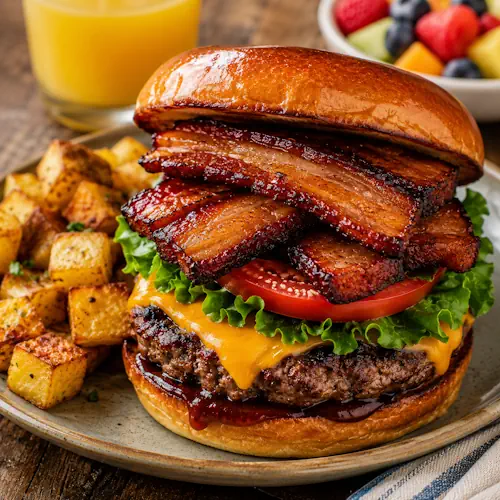
brunch burgers combine juicy beef patties, smoky pork belly, melted cheddar cheese, barbecue sauce, and toasted buns into a rich comfort food recipe packed with bold Southern barbecue flavor. The crispy pork belly adds deep smoky richness while the juicy burgers stay tender and flavorful.
This pork belly burger recipe remains popular because it transforms a classic cheeseburger into a hearty brunch-style barbecue meal. The combination of smoky pork belly, sharp cheddar, barbecue sauce, and grilled beef creates indulgent flavor perfect for weekends and cookouts.
Smoky pork belly creates rich barbecue flavor
The popularity of brunch burgers continues to grow because crispy grilled pork belly adds smoky texture and savory richness that pairs perfectly with juicy beef patties. The honey soy marinade also gives the pork belly subtle sweet smoky flavor during grilling.
Another reason this barbecue burger recipe works so well is the balance between smoky meat flavor and creamy melted cheese. Sharp cheddar and barbecue sauce help bring extra richness while lettuce and tomato add fresh contrast.
Juicy burgers and crispy toppings add texture
The grilled beef patties give this pork belly burger recipe juicy texture while the crispy pork belly creates crunchy smoky contrast in every bite. Toasted buns also help hold the rich barbecue ingredients together beautifully.
If you enjoy rich barbecue burger recipes, you may also like our Bejewelled BBQ Pork, another comforting recipe packed with smoky grilled flavor.
Texture plays an important role in this recipe. The burgers stay tender and juicy while the pork belly becomes crispy and caramelized during grilling.
The barbecue sauce also creates glossy smoky richness while the lettuce and tomato help balance the heavy savory flavors with freshness and crunch.
Perfect brunch burgers for weekends and cookouts
These brunch burgers work perfectly for weekend brunches, game day gatherings, outdoor cookouts, family dinners, and casual barbecue parties because the smoky burger flavors create satisfying comfort food everyone enjoys.
The burgers pair beautifully with fries, potato wedges, coleslaw, grilled corn, onion rings, baked beans, or extra barbecue sauce served on the side.
Proper food handling remains important whenever preparing ground beef and pork. Always cook burgers thoroughly and refrigerate raw meat properly before grilling. For additional food preparation and meat safety guidance, visit the FDA.
Ultimately, brunch burgers deliver juicy beef texture, smoky pork belly richness, melted cheddar flavor, and bold barbecue comfort in an indulgent burger recipe perfect for weekends.
prevents your screen from turning off”
Brunch Burgers With Pork Belly
Juicy cheeseburgers topped with crispy pork belly and smoky barbecue sauce.
If I’m going to indulge in a burger, I don’t mess around: I like to make ’em with about ½ pound of ground beef apiece. And yes, if you don’t feel like firing up your smoker, you can still enjoy this burger by doing the first step in the oven.
A half hour before you’re ready to cook your burger, preheat a smoker to 300°F.
(If you’re cooking these in the oven instead, preheat the oven to 300°F.
)
In a medium nonreactive bowl, combine the ground beef with the ranch dressing mix and the rub.
Using your hands, mix gently to combine, taking care not to overwork the meat.
Form into two patties of equal size (or three or four patties, if you like smaller burgers).
Transfer the burgers to a small and shallow aluminum baking pan.
Refrigerate them until the smoker (or oven) is ready.
Then place the pan in the smoker (or oven).
For medium-rare burgers, smoke for 15 minutes, or for medium-well burgers, go to 30 minutes.
Remove the burger pan from the smoker (or oven) and allow the burgers to rest, uncovered, while you melt the butter in a medium skillet over medium heat on a stovetop or gas grill (the smoker won’t be hot enough to give you a good sear).
When the butter is melted but not smoking, use a spatula to slide the burgers carefully into the skillet.
Cook for about 3 minutes, just until they’re seared on one side and a nice crust has formed, then flip them and do the same on the other side.
Top them with cheddar and then slide the burgers onto a platter and let them rest, lightly covered with aluminum foil.
While the burgers rest, wipe out the pan.
Over medium heat in that same pan, cook the Canadian bacon about 2 minutes per side, until each side is lightly crispy.
Using a spatula, slide the Canadian bacon onto paper towels to absorb any excess grease.
Toast the buns in your smoker or on a low setting in the toaster oven.
Smear a little mayonnaise on the bottom half of each bun.
Top with the cheeseburgers, a slice of Canadian bacon, a nice piece of cold, crisp Iceberg lettuce, a slice of ripe tomato, and pickles.
Smear the inside top of each bun with a little more mayonnaise.
Preheat all grates of a well-oiled charcoal or gas grill to high heat, about 400°F.
Season the steaks with rub on both sides and work it in with your hands.
Using your hands or a brush, evenly—but lightly—coat the steaks with olive oil.
Place the steaks on the grate, decrease the heat to medium, close the lid, and do not move the steaks until they are well marked and have a light char.
Flip them, close the lid, and continue to cook with the lid down to desired doneness, about 5 minutes per side for rare, about 6 minutes per side for medium rare, about 7 minutes per side for medium, and 9 to 10 minutes per side for medium-well to well-done.
Transfer the steaks to a platter and cover with aluminum foil.
Let rest for 10 minutes.
Make your steak sauce: Collect ¼ cup of the pan drippings from the platter.
Combine the juices with all of the sauce ingredients in a small saucepan.
Over medium heat, whisk continuously to combine.
Let the sauce just come to a boil, then remove the pan from the heat and set it aside.
To serve the steak, use a sharp knife to cut the meat across the grain in thick diagonal slices.
Pour the sauce over the slices, if you like, or serve it on the side for dipping.
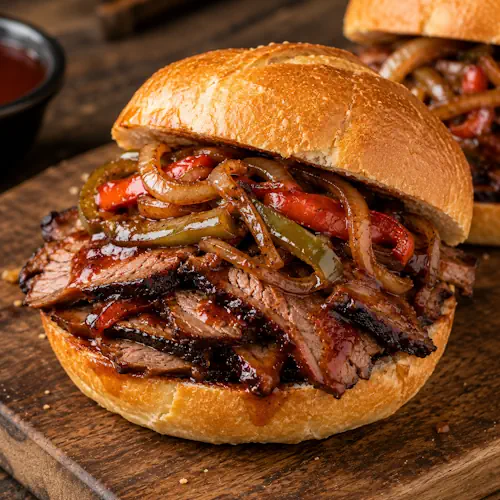
brisket sandwich combines tender sliced brisket, smoky barbecue sauce, sweet onions, peppers, and crusty toasted rolls into a rich comfort food recipe packed with bold barbecue flavor. The juicy brisket stays tender while the peppers and onions add sweetness and savory depth.
This barbecue sandwich recipe remains popular because it transforms leftover brisket into a hearty smoky meal perfect for lunch, dinner, or casual gatherings. The combination of barbecue sauce, toasted bread, caramelized onions, and tender brisket creates classic comfort food flavor.
Smoky brisket and barbecue sauce create rich flavor
The popularity of brisket sandwich recipes continues to grow because slow-cooked brisket develops deep smoky richness while barbecue sauce adds sweet tangy flavor. Worcestershire sauce, mustard, garlic, and hot sauce also help deepen the savory barbecue character.
Another reason this barbecue brisket recipe works so well is the balance between rich meat flavor and sweet vegetables. The onions and peppers soften beautifully while adding freshness and texture beside the smoky brisket.
Peppers and onions add sweet savory texture
The caramelized onions and peppers give this brisket sandwich recipe extra texture while the toasted sandwich rolls help absorb the rich barbecue sauce and beef juices. The thickened sauce also coats the brisket evenly for maximum flavor.
If you enjoy smoky barbecue sandwich recipes, you may also like our Barbecue Pulled Pork, another comforting barbecue recipe packed with rich smoky flavor.
Texture plays an important role in this recipe. The brisket stays tender and juicy while the toasted bread adds crisp bite and structure throughout the sandwich.
The peppers and onions also help balance the smoky richness while adding sweetness and soft texture beside the savory beef.
Perfect brisket sandwich for lunch and cookouts
This brisket sandwich works perfectly for lunch, dinner, weekend cookouts, game day gatherings, and casual family meals because the rich brisket filling creates satisfying barbecue comfort food flavor.
The sandwiches pair beautifully with fries, coleslaw, potato salad, baked beans, grilled corn, pickles, or extra barbecue sauce served on the side.
Proper food handling remains important whenever preparing beef and reheating leftovers. Always store brisket refrigerated and reheat thoroughly before serving. For additional food preparation and meat safety guidance, visit the FDA.
Ultimately, brisket sandwich delivers juicy smoked beef texture, sweet peppers and onions, smoky barbecue richness, and toasted bread comfort in a satisfying sandwich recipe perfect for barbecue lovers.
prevents your screen from turning off”
Brisket Sandwich With Peppers And Onions
Tender brisket sandwiches with smoky barbecue sauce, peppers, and sweet onions.
115- to 20-pound whole untrimmed brisket, preferably wagyu beef
¾cupJack’s Old South Hickory Rub or make your ownthis page
1recipeBeef Marinadedivided for injection
Instructions
1 solid cutting board
1 sharp boning or paring knife
2 aluminum baking pans
1 heavy-duty meat injector
1 insulated moving blanket
Notes & Wine Advice
Trim your brisket
Fit the brisket snugly and fat side up in an aluminum baking pan. Make sure the pan is large enough to fit the whole brisket but not so large that the brisket slides around too much in it. Inject the brisket (see how on this page): You want to inject half of the marinade—16 ounces total. Do that by simply eyeballing 1-inch squares and injecting the marinade all over the brisket. Once you’ve injected 16 ounces of liquid, flip the brisket over so that it’s fat side down and pour the remaining marinade over the meat. Cover the pan tightly with aluminum foil and refrigerate at least six hours, or preferably overnight.
Thirty minutes before you are ready to smoke your brisket, prepare your smoker and heat it to 350°F. You can also use a gas grill, but you’ll need to prepare it for smoking (see this page).
Remove the brisket from the marinade, discard the marinade, and use paper towels or a clean kitchen towel to pat the brisket dry all over. Using your hands, apply the beef rub all over the meat. Place the brisket snugly in a clean aluminum baking pan. Place the pan in the smoker, close smoker cover, and smoke for 2½ hours.
Remove the pan from the smoker and cover it with aluminum foil. Put it back into the smoker and cook for another 1½ hours, or until the temperature in the point end of the brisket reaches 205°F.
Remove the pan from the smoker. Wrap the pan, still covered with foil, in the insulated blanket. Let it rest at room temperature in a cool dry place for no less than 3 hours; 4 hours is optimal.
After 3 to 4 hours of resting, unwrap the pan from the blanket. Discard the foil, and then transfer the brisket to a cutting board, taking care to save the accumulated pan juices. Let the brisket continue resting on the cutting board. Strain the pan juices of all grease, and then pour the juices into a medium saucepan. Warm the juices over medium heat and allow them to come to a simmer. Meanwhile, using a large serrated knife, slice the brisket against the grain into slices of about ⅛- to ¼-inch thick, depending on your taste. Try to make the slices as consistent as possible. Place the slices on a warm platter and pour the juices over them. Serve immediately.
Unwrap your reserved slab of ribs and transfer it to a cutting board.
Using a very sharp long chef’s knife, you want to cut a wide horizontal slice across the whole rack.
You will be left with two very long uninterrupted slices of boneless rib meat.
close to the meat when trimming, or you’ll leave some bald patches without any fat.
So don’t trim too much, but you’ve got to trim enough so that the rub adheres nicely and you don’t end up with a piece of meat that is tough to chew when fully cooked.
If you don’t like to waste anything, save what you trim off for sausage and it’ll be delicious.
The first mutton contest I ever entered I won, and here’s how I cooked the lamb chops, just like this here. Note: I like to get the largest rack of lamb I can find, so I can get chops that are at least 1-inch thick apiece. Gives people something to sink their teeth into.
To provide the best experiences, we use technologies like cookies to store and/or access device information. Consenting to these technologies will allow us to process data such as browsing behavior or unique IDs on this site. Not consenting or withdrawing consent, may adversely affect certain features and functions.
Functional
Always active
The technical storage or access is strictly necessary for the legitimate purpose of enabling the use of a specific service explicitly requested by the subscriber or user, or for the sole purpose of carrying out the transmission of a communication over an electronic communications network.
Preferences
The technical storage or access is necessary for the legitimate purpose of storing preferences that are not requested by the subscriber or user.
Statistics
The technical storage or access that is used exclusively for statistical purposes.The technical storage or access that is used exclusively for anonymous statistical purposes. Without a subpoena, voluntary compliance on the part of your Internet Service Provider, or additional records from a third party, information stored or retrieved for this purpose alone cannot usually be used to identify you.
Marketing
The technical storage or access is required to create user profiles to send advertising, or to track the user on a website or across several websites for similar marketing purposes.
To provide the best experiences, we use technologies like cookies to store and/or access device information. Consenting to these technologies will allow us to process data such as browsing behavior or unique IDs on this site. Not consenting or withdrawing consent, may adversely affect certain features and functions.
Functional
Always active
The technical storage or access is strictly necessary for the legitimate purpose of enabling the use of a specific service explicitly requested by the subscriber or user, or for the sole purpose of carrying out the transmission of a communication over an electronic communications network.
Preferences
The technical storage or access is necessary for the legitimate purpose of storing preferences that are not requested by the subscriber or user.
Statistics
The technical storage or access that is used exclusively for statistical purposes.The technical storage or access that is used exclusively for anonymous statistical purposes. Without a subpoena, voluntary compliance on the part of your Internet Service Provider, or additional records from a third party, information stored or retrieved for this purpose alone cannot usually be used to identify you.
Marketing
The technical storage or access is required to create user profiles to send advertising, or to track the user on a website or across several websites for similar marketing purposes.